
Key takeaways
- The shaker profile is the whole style in one detail. A plain slab door in the same white reads modern, not Hamptons, no matter what else you put around it.
- Spend the navy once. A navy island in an otherwise white kitchen works. Navy island, navy pantry and navy stools cancel each other out.
- Keep the architecture, change the surfaces. House Design AI holds your walls, windows and proportions in place, so what you are judging is the finish rather than a different kitchen.
- A full restyle is 10 credits and a targeted edit is 5, and you see the cost before anything runs.
What is a Hamptons kitchen?
A Hamptons kitchen is a coastal-classic kitchen built on white shaker joinery, a honed white stone benchtop and one deep navy used sparingly. The detail does the work rather than the colour. A profiled door front, board lines behind the bench, a panelled hood over the cooktop and cup pulls in brushed nickel will read Hamptons long before any furniture arrives.
It suits Australian kitchens for an unglamorous reason. Most of them are a galley or an L with an island, in a room that also has to hold a fridge, a dishwasher and a good deal of daily life. A mostly white kitchen with one dark anchor absorbs that better than a kitchen built on a mid tone, because the clutter sits against white rather than arguing with a second colour.
It is also the style most often overdone. Navy on the island, navy on the pantry, navy on the stools and navy on the pendant leaves nothing white to push against, and the room ends up reading heavy rather than crisp. Most of the decisions below are about restraint.
The Hamptons palette and materials
Soft white is the ground, and in a kitchen it belongs on the doors, the walls and the hood. Marble grey is the veining in the stone and the movement in the splashback, and it is what stops all that white from going flat. Pale sky is optional, useful inside a glass-front cupboard or on a rear pantry. Rattan is the warmth, which in a kitchen usually arrives as stools, a basket or a woven pendant. Muted navy is the one dark note.
Materials matter more here than in any other room, because a kitchen is read at close range and touched all day. Honed white stone rather than polished. Brushed nickel rather than chrome. A real shaker door with a deep enough rail to cast a shadow, rather than a shallow routed imitation that disappears in flat light.
If you want a shortcut, choose the white and commit to it on every cupboard face, then allow yourself one dark colour and one woven material. That is most of a Hamptons kitchen before you have priced a single appliance.
7 Hamptons kitchen ideas
1. Put a shaker profile on every door
The profiled front is the tell. A flat slab door in exactly the same white reads modern and slightly clinical, while the same white with a shaker rail and stile reads like joinery someone thought about.
Keep the profile consistent across the whole kitchen, including the panel on the end of the island and the doors on the appliance bank. Mixing a shaker door with a slab drawer front is the most common way a nearly-right kitchen ends up looking assembled from two catalogues.
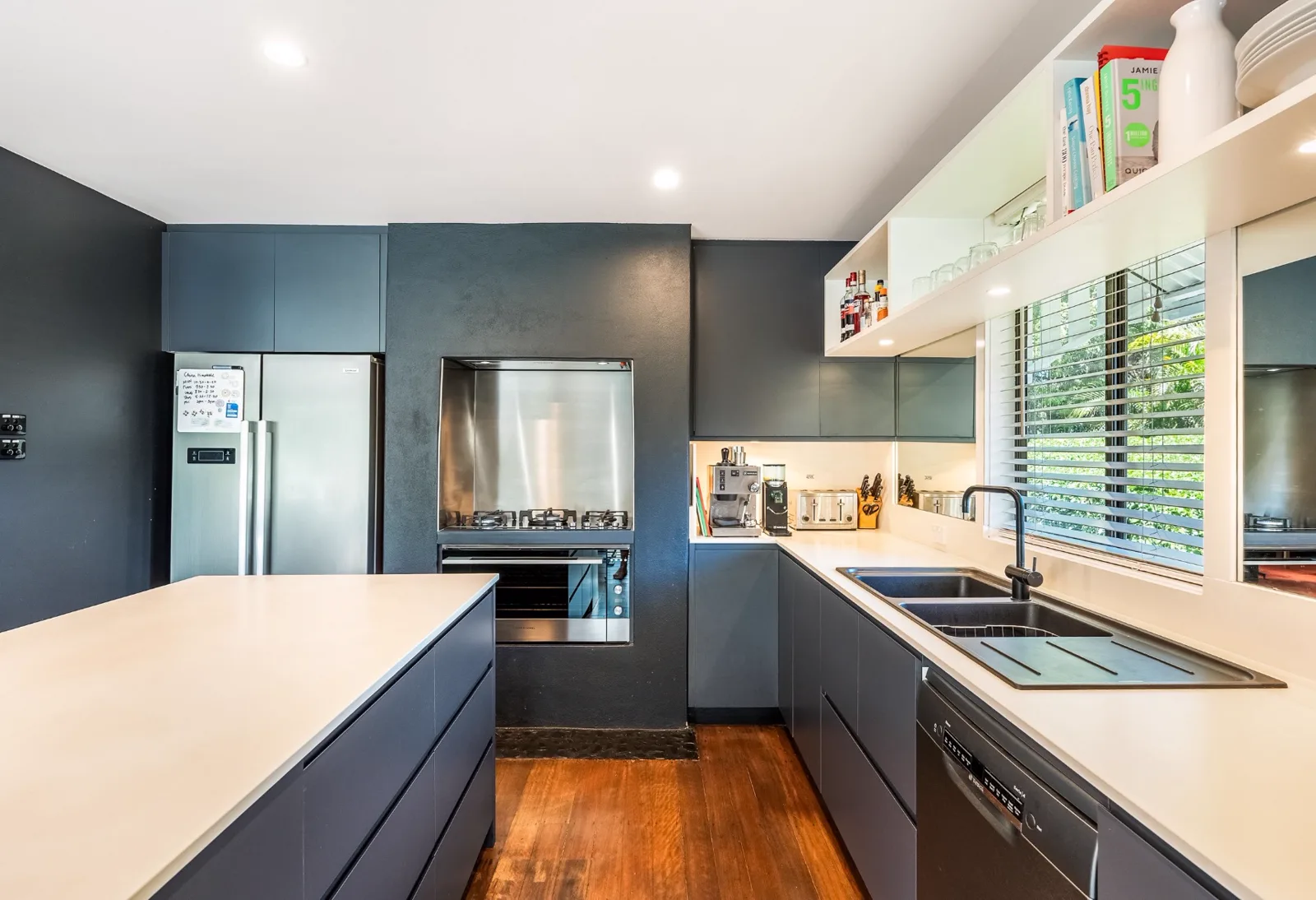
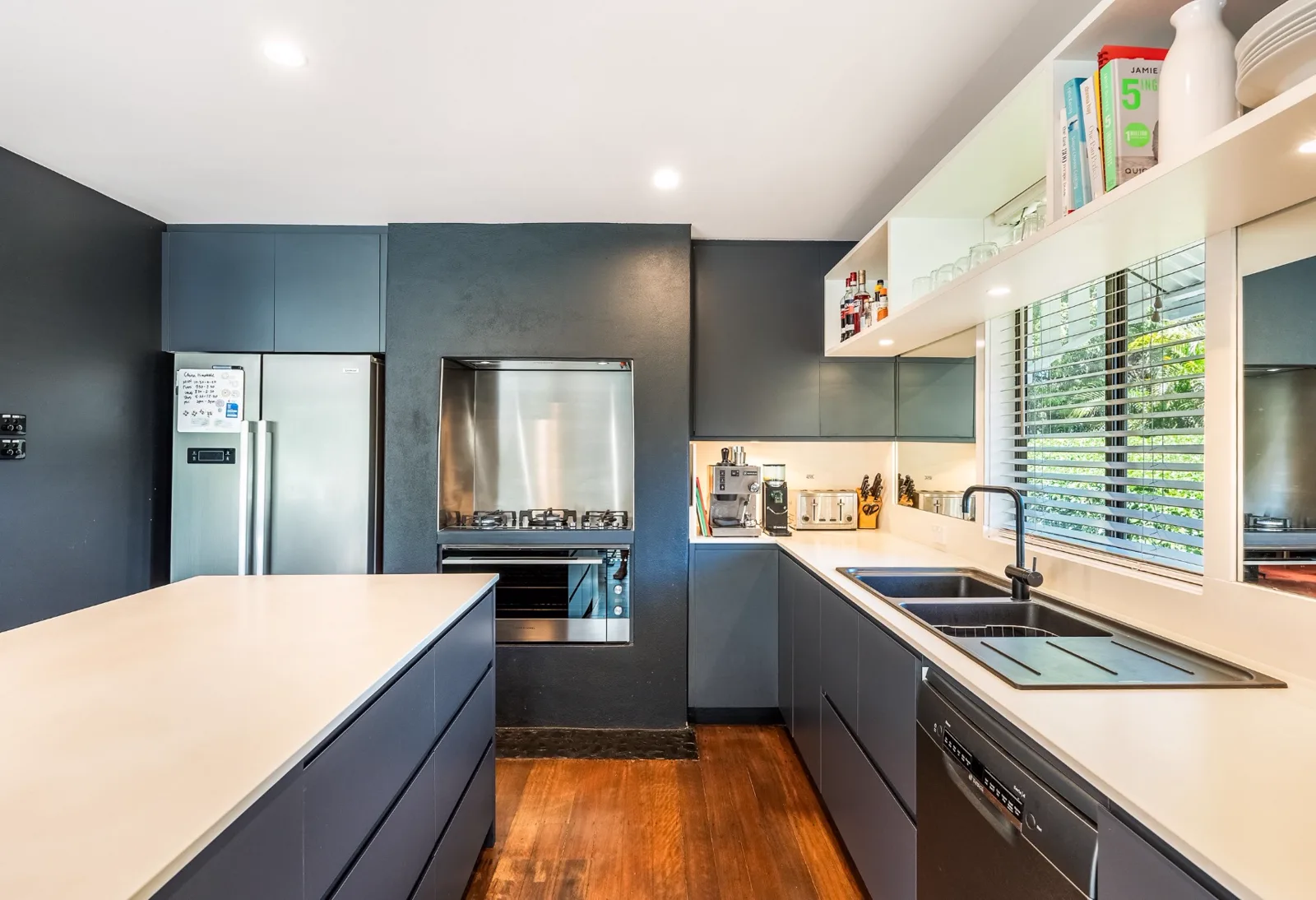
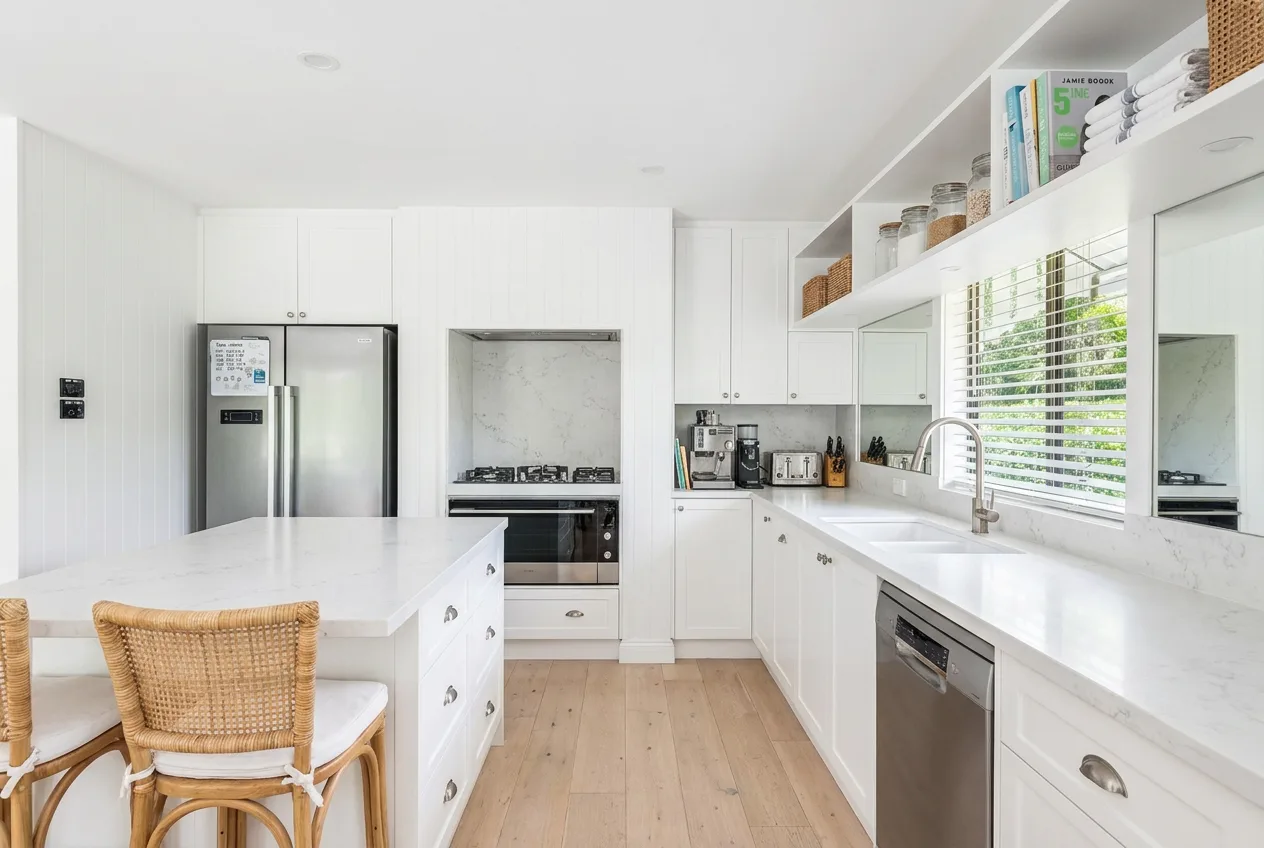
Look at the pair at the top of this page. It is the same kitchen in both frames: the same window on the right, the same recessed alcove for the cooktop, the same open shelf above the bench, still holding books, the same island in the same place. The doors changed from dark slab to white shaker, and that alone moves the room across.
2. Take the benchtop to a honed white stone
White stone with soft grey veining is the surface this style was built around. It holds the room bright, it takes the panelling without competing, and honed rather than polished keeps it from glaring under downlights.
Carry the same stone up the splashback if the budget allows, even for a single run. A stone return reads as one continuous surface and hides the join line that a tiled splashback always has to negotiate.
3. Panel the splashback instead of tiling it
VJ boards or beadboard behind the bench is the quieter half of the Hamptons splashback question, and it is the one that carries the style furthest. The vertical lines pick up the shaker profile on the doors, so the whole kitchen reads as one piece of joinery.
Subway tile is the other correct answer. Lay it in a running bond with a white or pale grey grout, and resist the dark grout that makes a kitchen look like a train station. Herringbone is a step further and works best in a small run where it can be a feature rather than the whole wall.
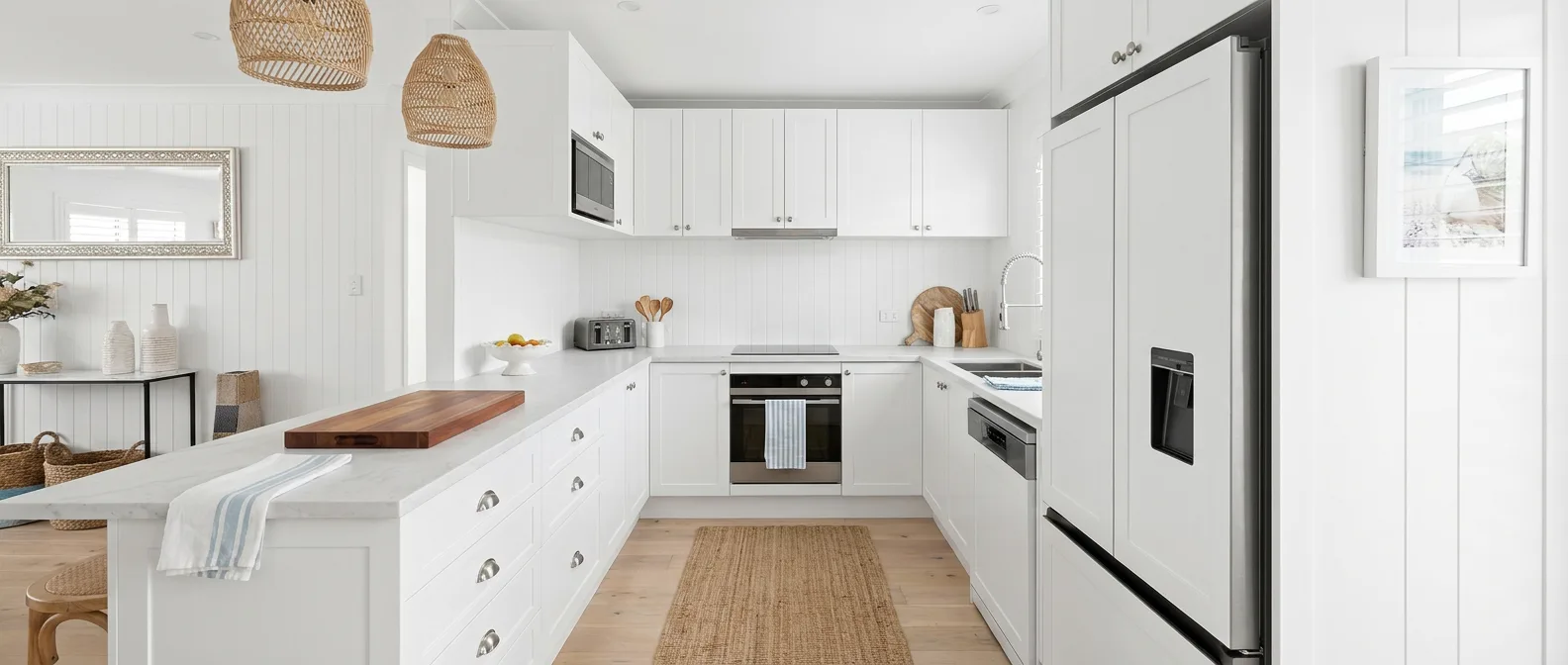
That is the same source photo run a second time. The two takes agree on the things that matter, white shaker fronts, a pale stone benchtop, board lines on the walls and pale oak underfoot, and they disagree on the layout as well as the styling. Be honest about that second frame, though: it has rearranged the plan rather than only the finishes, so read it for its materials rather than its layout. A second run is another full restyle.
4. Spend the navy once, usually on the island
One deep navy element in an otherwise white kitchen gives the eye somewhere to land. The island is the natural place for it, because it is the piece you see from the living room and the one that reads as furniture rather than storage.
If the island is small or the kitchen is dark, put the navy on a pantry door or the bank of drawers under the cooktop instead. The rule is not where it goes, it is that it goes in one place.
Deep green and soft grey-blue both substitute cleanly if navy feels too expected.
See your own kitchen in Hamptons before you quote the joinery Upload one photo and get it back in about a minute.
Upload a photo5. Build a panelled hood over the cooktop
A mantel-style hood is the one piece of theatre this style allows, and it is what turns a white kitchen into a Hamptons one. Panel it in the same profile as the doors, take it up to the cornice or the ceiling, and let it be the tallest thing in the room.
A stainless canopy or an undermount rangehood is not a failure, and in a low ceiling it is the sensible choice. If you go that way, put the emphasis somewhere else, usually the splashback or the island, so the cooking wall still has a centre.
6. Glass-front uppers, or open shelves, but not everywhere
A run of glass-front cabinets breaks up a solid wall of white doors and gives the kitchen some depth. Two doors is usually enough, ideally at the end of a run or flanking the window.
Open shelving does the same job and is easier to live with if you already own things worth looking at. Keep what sits on it to a narrow palette, white ceramics, clear glass and a few timber boards, or it turns into visible clutter rather than styling.
7. Brushed nickel tapware and a farmhouse sink
Brushed nickel is the Hamptons metal in a kitchen. It is softer than chrome, cooler than brass, and it disappears into a white room instead of announcing itself. A gooseneck mixer with a cross handle or a simple lever both suit, and a pull-out spray is worth the small loss of purity.
A farmhouse or apron sink is the classic finish to the run, and it is a genuine upgrade in daily use as well as in looks. It needs a cabinet built for it, so it belongs in a renovation rather than a refresh.
Match the cabinet hardware to the tapware and stop there. Cup pulls on the drawers and knobs on the doors is the traditional pairing, and mixing a third metal into it is the fastest way to lose the discipline that makes this style work.
What it costs
Trying Hamptons on your own kitchen in House Design AI is a full restyle, which is 10 credits for that room.
If a version is close but not quite right, a targeted edit is 5 credits. That is the one to use when you want to change the flooring, repaint a wall or remove a piece of furniture without regenerating the whole kitchen from scratch.
Credit packs are bought in the iOS and Android app, and the balance is shared with the web app, so credits you buy on your phone are there when you open the site on a laptop. Credits never expire and there is no subscription.
Hamptons vs Coastal: what is the difference?
| Hamptons | Coastal | |
|---|---|---|
| Base palette | Crisp white with one muted navy | Sandy beige with soft white |
| Timber | Pale oak floors, painted joinery | Blonde and weathered timber joinery |
| Pattern | Shaker profiles, beadboard, subway tile | Little pattern, grain and texture |
| Accents | Brushed nickel, glass-front uppers, marble | Aged brass, rope, ceramics |
| Feel | Tailored, classic, quietly formal | Casual, sun-bleached, barefoot |
Hamptons kitchen FAQ
Does Hamptons work in a small kitchen?
Yes, and a galley is one of the easiest rooms to do it in, because the palette is mostly white and the bench runs are already simple. Keep the uppers light or leave a run of open shelving, and put the one dark colour low down where it grounds the room instead of closing it in. The things that shrink a small Hamptons kitchen are heavy dark uppers and a busy patterned splashback.
What benchtop suits a Hamptons kitchen?
A honed white stone with soft grey veining is the classic answer, because it reads like marble without the maintenance and it keeps the room bright. A plain white with no movement can look flat next to all that panelling, and a heavily speckled stone fights it. Pale timber on an island or a butcher block is the one warm exception that always works.
Can I see Hamptons on my own kitchen before buying anything?
Yes. Upload one photo of your kitchen in House Design AI, choose Hamptons, and you get that kitchen back with its walls, windows and proportions kept as they are. A full restyle costs 10 credits, and you see the cost before anything runs.
Is Hamptons the same as Coastal?
They are close cousins, not the same thing. A Hamptons kitchen is the more tailored of the two, built on profiled shaker fronts, white stone and brushed nickel, with the panelling doing the pattern work. A Coastal kitchen is looser and sandier, leaning on weathered timber, aged brass and texture instead of profile.
Written by the House Design AI team
Every guide is written by the people building House Design AI and checked against what the app actually does before it is published. When the app changes, the guide is updated and the date above moves.
See every featureHamptons in other rooms
Other kitchen styles
Your room, this style
Stop imagining it. See it.
Upload one photo of your kitchen and get a Hamptons version in about a minute. Walls, windows and proportions stay exactly as they are.