
Key takeaways
- Contemporary is a materials palette, not a colour scheme. Render, stone and timber in warm greys will carry a facade that paint alone cannot.
- Black frames are the cheapest single move. Changing the window frames to charcoal sharpens a facade before anything else is touched.
- Keep the architecture, change the surfaces. House Design AI holds your walls, windows and proportions in place, so what you are judging is the finish rather than a different house.
- A full facade restyle is 10 credits, Landscaping is a 5-credit targeted edit, and you see the cost before anything runs.
What is a Contemporary exterior?
A Contemporary exterior is a current, restrained facade built out of three materials rather than a colour scheme. Render in a warm grey carries the bulk of the wall, natural stone gives the base weight, and timber warms the parts you walk past or touch. Window frames go black or charcoal, the roofline flattens, and almost nothing is applied for decoration.
The reason it suits so many Australian houses is that it does not need period features to look right. A plain two storey box from the seventies has exactly the massing this style wants, and the work is all in the surfaces. Nothing has to be added back that the house never had.
The failure mode is fussiness. Four materials, a feature colour, a curved wall and a decorative screen produce a facade that is busy rather than modern. Restraint is not a stylistic preference here, it is the style.
The Contemporary palette and materials
Warm white and greige are the render, and warm is the operative word, because a cool grey render turns blue in overcast light and reads cheap. Stone is the base course and any pier or retaining wall, and it should be a natural stone with real colour variation rather than a printed panel. Warm timber is the deck, the entry cladding or the front door, and it is the only material allowed to be a colour. Charcoal is the frames, the roof and the gutters.
Proportion is what separates a good version from a flat one. The stone runs low and heavy, the render sits above it, and the timber lands on one element and stops. Wrapping the entry, or the projecting upper room, in timber gives that element a job to do and leaves the rest of the facade quiet.
If you want a shortcut, take the frames to charcoal, render everything in one warm grey and put a stone base under it. That is a Contemporary facade before the timber has even arrived.
7 Contemporary exterior ideas
1. Render the walls in one warm grey
One render colour across the whole facade is what gives this style its calm. Resist the two-tone version where a feature panel is picked out in a darker grey, because it chops the wall into pieces the architecture never asked for.
Choose a warm grey or a greige rather than a cool one, and look at the sample outdoors at three times of day before committing. Render reads noticeably cooler in shade than it does on a chart.
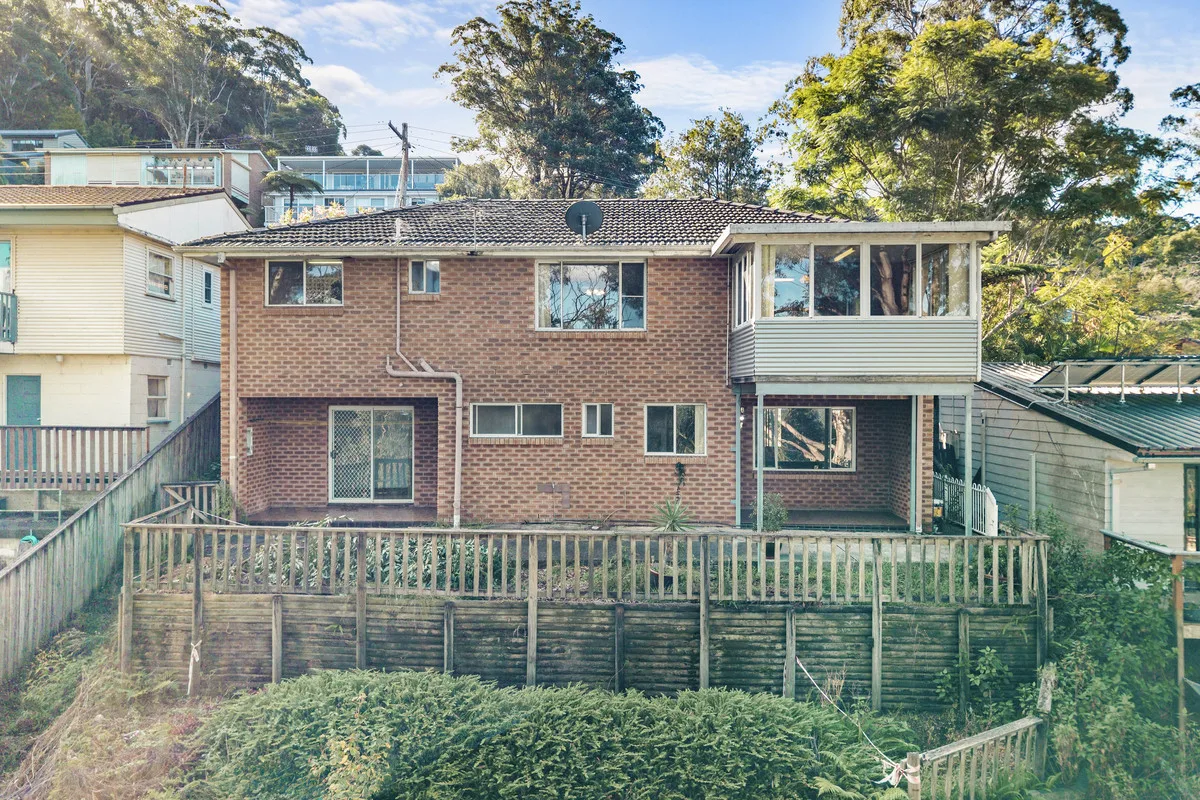
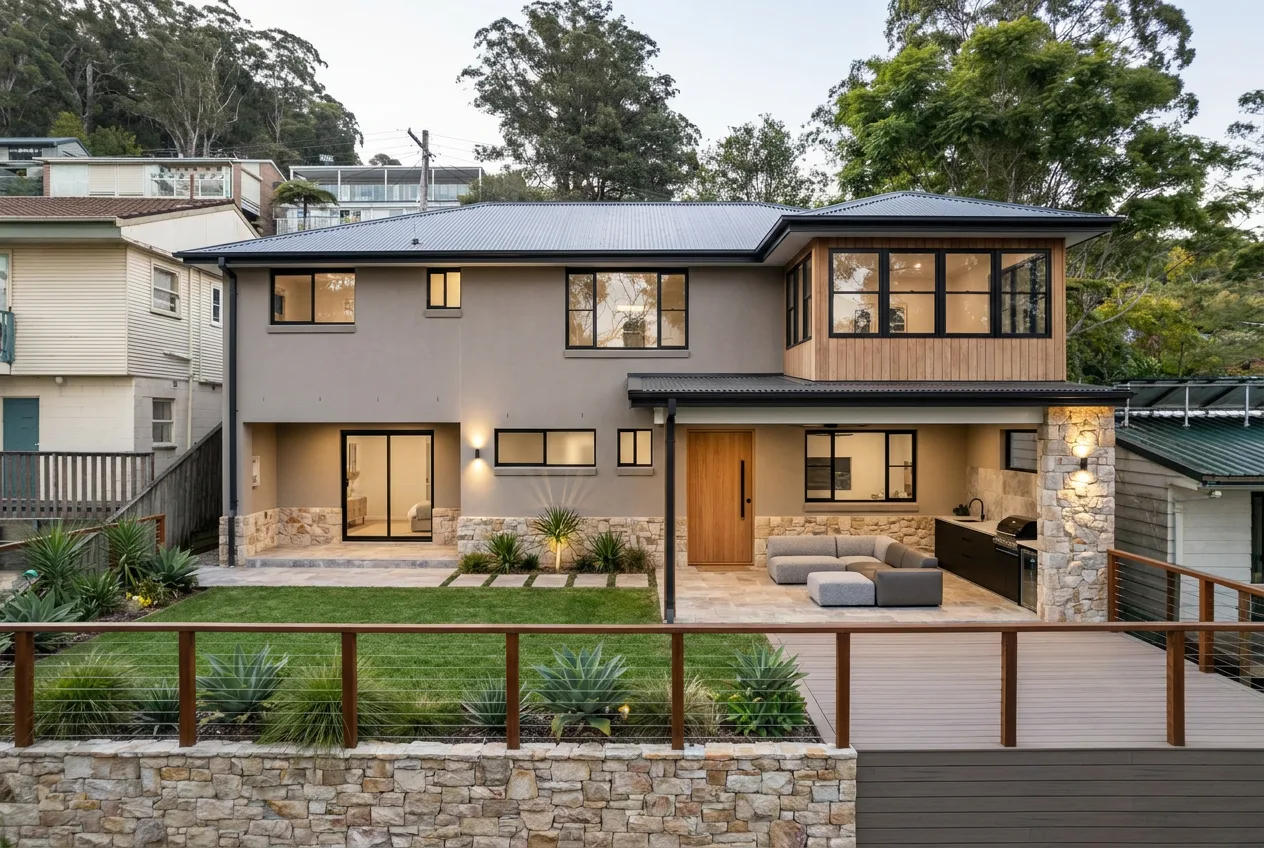
The pair at the top of this page is the same house in both frames. Same two storeys and the same massing, the same projecting upper room on the right, the same neighbours either side, the same gum trees behind, and the same drop from the yard down to a fence across the front. The brick becomes render over a stone base, the roof and the frames go dark, and the yard is rebuilt around a lawn. It is also generated at dusk, which flatters the lighting, so judge the materials rather than the time of day.
2. Take the window frames to black or charcoal
Dark frames against a pale wall are the cheapest sharpening move available, and on a house with aluminium windows it can be as small a job as a repaint or a reskin.
The effect is structural rather than decorative. Black frames read as a drawn line around each opening, which makes the windows look intentional and the wall look flatter, both of which this style wants.
Carry the same charcoal to the gutters, the downpipes and the roof. A dark frame with a white gutter above it undoes half the work.
3. Flatten the roofline
A flat, skillion or very low pitched roof is what makes a facade read modern before any material is chosen. Where the roof is being replaced anyway, a dark standing seam or corrugated metal profile does the job and suits the palette.
Where it is not, the achievable version is to make the roof recede. Take the tiles or sheeting to a dark charcoal, remove the ornament at the ends, and let the eye go to the wall instead.
A deep, flat eave over the ground floor is the other half of this. It throws a hard shadow line across the facade, which is the detail a Contemporary house uses instead of trim.
4. Wrap one element in timber
Timber is the warmth in a palette that is otherwise mineral, and it works hardest when it wraps a whole element rather than appearing as a stripe. The entry, the projecting upper room or the underside of a soffit are the three that pay off.
A timber front door does the smallest version of this and is worth doing on its own. Wide, plain, in a warm species with a vertical grain, and left as the only warm thing on the facade.
See your own house in Contemporary before you quote the render Upload one photo and get it back in about a minute.
Upload a photo5. Plant in structure, not in colour
Contemporary planting is architectural. Agaves, grasses, clipped forms and a few repeated species, set in mulch or gravel, with the shapes doing the work that flowers do in other styles.
Repetition is the whole technique. Three of the same plant in a row reads designed, while one of nine different things reads like a nursery trolley. Keep the palette green and silver and let the stone and the render be the colour.
Gravel between pavers, or a strip of it against the wall, is the detail that ties the planting to the paving. It also solves the awkward line where a garden bed meets a rendered wall.
6. Light it linearly and hide the source
Lighting is where a Contemporary facade earns its keep after dark, and the rule is that you should see the light and not the fitting. Uplights at the base of a wall, a strip under a bench or a step, and a wall washer beside the entry.
Warm the temperature. Cool white light makes render look grey and dead, while a warm globe makes it look like stone. This is the single most common lighting mistake on an otherwise good facade.
Keep the fittings matte black and few. Two well placed lights beat six scattered ones, and a facade lit evenly all over has no shape at all.
7. A wide entry door, and no other colour
The front door is the one place this style allows a gesture, and the gesture is scale rather than colour. A wide door, ideally a pivot, in timber or in the same charcoal as the frames, with a long vertical handle and nothing else on it.
Give it a clear approach. Wide stone pavers, a level landing and a plain rendered wall either side is all the entry needs, and it will look better than any amount of screening or feature cladding.
Then stop adding. No feature colour, no decorative screen, no second stone. The restraint is the point, and it is also the part that keeps the facade looking current for the longest.
What it costs
Trying Contemporary on your own house in House Design AI is a full facade restyle, which is 10 credits for that photo.
Landscaping is a targeted edit at 5 credits, which is the one to use when the house itself is right and it is the garden, the paving or the planting you want to see differently. Any other targeted edit is 5 credits as well, so repainting the walls or removing something from the shot without regenerating the whole facade costs half of a full restyle.
Credit packs are bought in the iOS and Android app, and the balance is shared with the web app, so credits you buy on your phone are there when you open the site on a laptop. Credits never expire and there is no subscription.
Contemporary vs Hamptons: what is the difference?
| Contemporary | Hamptons | |
|---|---|---|
| Base palette | Warm greys with charcoal trim | Soft white with a grey roof |
| Timber | Natural timber decks and entry cladding | Painted weatherboard, white posts |
| Pattern | Almost none, material change instead | Board lines, gables, shutters |
| Accents | Black frames, stone, linear lighting | Navy door, brass or black lanterns |
| Feel | Sleek, current, restrained | Classic, coastal, welcoming |
Contemporary exterior FAQ
Does Contemporary work on an older brick house?
Yes, and a plain brick house is one of the easiest starting points, because the massing is already simple. Rendering the walls in a warm grey and adding a stone base course does most of the work, and recladding one element in timber gives the facade the warmth render alone cannot. What fights it is a heavily patterned or multi-toned brick left showing through in patches.
What cladding suits a Contemporary exterior?
Render is the base, natural stone is the weight and timber is the warmth, and a good facade usually uses all three in that order of quantity. Keep each material to a whole element rather than a stripe, so the stone runs the full base and the timber wraps the whole entry. A facade cut into four materials reads busy no matter how good the materials are.
Can I see Contemporary on my own house before rendering anything?
Yes. Upload one photo of your house in House Design AI, choose Contemporary, and you get that house back with its walls, windows and proportions kept as they are. A full facade restyle costs 10 credits, and you see the cost before anything runs.
Is Contemporary the same as Hamptons?
No, and outside they are easy to tell apart. Contemporary is built on render, stone and timber in warm greys, with a flatter roofline, black frames and no applied detail. Hamptons is built on painted boards, gables, verandahs and white trim, with the detail carried by shadow lines and joinery rather than by material change.
Written by the House Design AI team
Every guide is written by the people building House Design AI and checked against what the app actually does before it is published. When the app changes, the guide is updated and the date above moves.
See every featureContemporary in other rooms
Other exterior styles
Your room, this style
Stop imagining it. See it.
Upload one photo of your exterior and get a Contemporary version in about a minute. Walls, windows and proportions stay exactly as they are.